
Holiday Homes Under the ATO Spotlight: New Guidance for Property Owners
Written by Lavinia Pera & Shara Cox

If you own a holiday home and claim tax deductions for expenses relating to the property, it may be time to review your arrangements.
The Australian Taxation Office (ATO) has recently finalised Practical Compliance Guideline PCG 2026/3, which outlines its compliance approach to holiday homes that are both rented out and used privately. The guidance reinforces that taxpayers can generally only claim deductions where the property is genuinely being used to produce assessable rental income and that private use may affect the deductions available.
Importantly, the ATO's new guidance goes beyond the traditional requirement to simply apportion expenses for private use. The ATO considers that section 26-50 of the Income Tax Assessment Act 1997 may deny certain ownership-related deductions where a holiday home is not mainly used, or held for use, for the purpose of deriving rental income.
A Greater Focus on Commercial Intent
The ATO's compliance approach looks beyond whether a property is merely advertised for rent. Instead, it considers whether the property is genuinely being operated as an income-producing asset.
When determining whether a holiday home is mainly used to derive rental income, the ATO considers the overall pattern of use, including factors such as:
The level of rental occupancy achieved.
The extent of personal use by owners, family members and friends.
Whether the property is made available during peak holiday periods.
Rental pricing and commercial terms.
Efforts made to attract paying guests and maximise bookings.
The ATO has adopted a Green, Amber and Red zone framework to assist taxpayers in understanding the compliance risk associated with their holiday home arrangements.
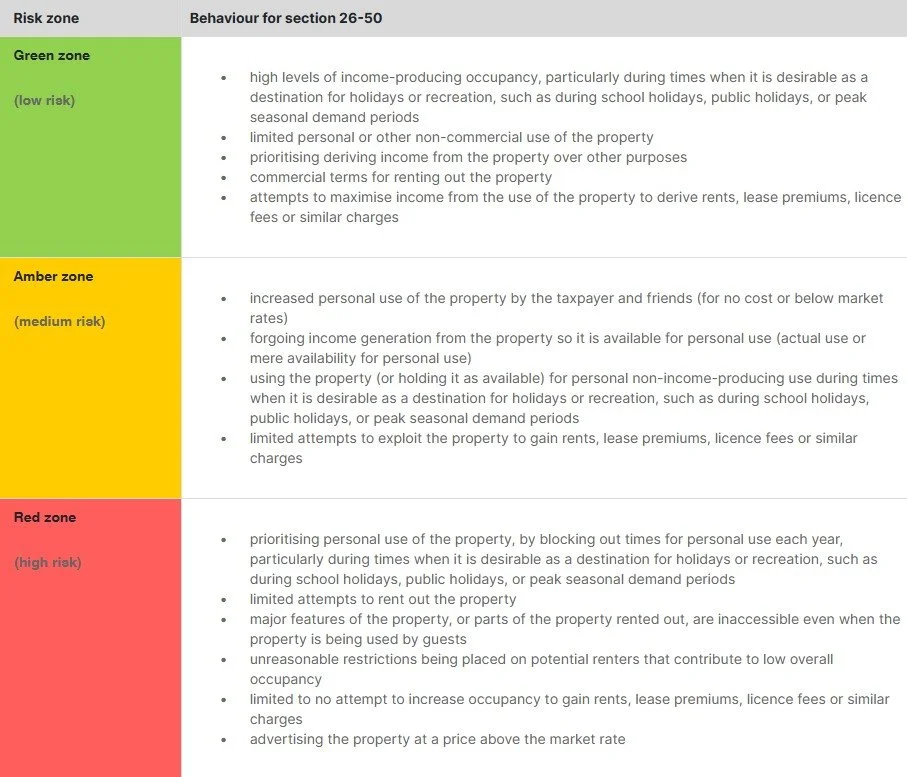
Image provided by the ATO https://www.ato.gov.au/law/view/document?DocID=COG/PCG20263/NAT/ATO/00001&PiT=99991231235958
Green Zone: Low Risk
Property owners are more likely to fall within the ATO's low-risk category where there is a clear and demonstrable commercial focus. Indicators include:
High levels of rental occupancy, particularly during peak holiday periods.
Limited personal use of the property.
Prioritising rental income over personal enjoyment.
Commercial rental arrangements and active efforts to maximise bookings.
Making the property genuinely available to paying guests when demand is highest.
In these circumstances, the ATO indicates it is unlikely to apply compliance resources to review the application of section 26-50.
Amber Zone: Proceed with Caution
The ATO may take a closer look where there are signs that personal use is beginning to outweigh commercial objectives. Examples include:
Increased private use by owners, family members or friends.
Letting family or friends stay at below-market rates.
Keeping the property available for personal use during high-demand periods.
Moderate rental occupancy levels.
Limited efforts to market the property or maximise rental income.
While these arrangements are not necessarily incorrect, taxpayers should ensure they maintain comprehensive records and can demonstrate that the property is being operated with a genuine income-producing purpose.
Red Zone: Higher Risk of Review
Property owners may attract greater ATO attention where there is little evidence of genuine commercial exploitation of the property. Examples include:
Prioritising personal use over rental opportunities.
Blocking out significant periods for private use.
Making only limited attempts to secure bookings.
Imposing restrictions that make the property unattractive or unavailable to renters.
Failing to actively market the property or increase occupancy rates.
In these circumstances, the ATO may question whether the property is mainly used, or held for use, to derive rental income and whether deductions have been claimed correctly
What Should Property Owners Do?
If you own a holiday home that is used both privately and to generate rental income, it is important to keep detailed records of:
Rental periods and occupancy rates.
Private use by owners, family members or friends.
Rental income received.
Advertising and marketing activities.
Booking enquiries and rental agreements.
Any discounted, non-commercial or below-market use arrangements.
Good records will help support the treatment adopted in your tax return and demonstrate the property's income-producing purpose if reviewed by the ATO.
Key Takeaway
The ATO's message is clear: simply listing a holiday home for rent may not be enough to support full deduction claims. Property owners should be able to demonstrate that the property is mainly used, or held for use, to derive rental income and that they are actively seeking to maximise the property's commercial return. Where this cannot be demonstrated, the ATO considers that section 26-50 may deny certain ownership-related deductions, in addition to the normal rules requiring private expenses to be excluded or apportioned.
For further information, refer to the ATO's Practical Compliance Guideline PCG 2026/3: ATO PCG 2026/3 – Holiday Homes Compliance Approach.
Need Advice?
If you own a holiday property and are unsure how the new ATO guidance may affect your tax position, please contact our office. We can help you review your arrangements and ensure your deductions are being claimed correctly before the ATO comes knocking.