
Will Your Children Lose Thousands of Dollars From Your Super?
Written by Steve Landers

Most Australians don't realise their superannuation can be taxed after they die. Your family could lose tens or even hundreds of thousands of dollars if you don't plan ahead.
For most Australians, superannuation is viewed as a tax-effective way to build wealth for retirement. But there is a little-known trap hidden within the system that can significantly reduce the amount your family ultimately receives when you're gone.
It's often called the "super death tax", and for many families, it can mean up to 17% of a superannuation death benefit being lost to tax.
Who Gets Hit With The Tax?
When a superannuation member dies, the tax treatment depends on who receives the money.
If your super is paid to your spouse the death benefit is generally received tax-free.
However, if your super passes to a non-tax dependant, such as an adult independent child the taxable component of your super can be taxed at up to 17%
The Hidden Cost
Let's look at a simple example.
John dies with $1,000,000 in super.
His super balance consists mainly of taxable components.
John leaves the money equally to his two adult children.
Potential tax payable:
$1,000,000 × 17% = $170,000
Amount received by family: $830,000
The Australian Taxation Office may receive more money than some beneficiaries.
For larger super balances, the numbers become even more alarming.
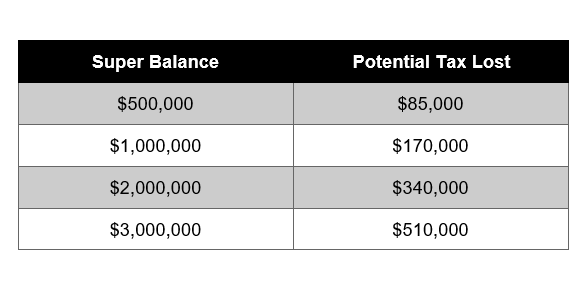
Why So Many People Get Caught
The problem is that most people focus on:
Their Will
Their investments
Their family trust
Their property portfolio
But they forget one critical fact:
Superannuation does not automatically follow your Will.
Instead, it sits in its own legal structure with its own tax rules.
A perfectly drafted Will can still result in a significant tax bill if the superannuation strategy isn't carefully considered.
The Good News: There May Still Be Time
The tax isn't always unavoidable.
Depending on your circumstances, strategies may include:
Gradually withdrawing super and investing personally
Re-contribution strategies
Restructuring pension and accumulation accounts
Estate planning through appropriate beneficiaries
Managing taxable and tax-free components over time
The earlier these strategies are considered, the more options may be available.
Unfortunately, once a person has died, the opportunity to restructure has generally disappeared.
The question is:
Do you know how much of your super would actually reach your children if you died tomorrow?
If you're unsure, now is the time to find out.
Don't Let The Tax Office Be Your Largest Beneficiary.
The good news is that with proactive planning, there may be strategies available to help reduce or avoid this tax. If you'd like to understand how your superannuation would be distributed and whether your family could be exposed to a significant tax bill, contact Salt Financial Group to arrange a review.