
Trust tax reform passes Parliament: what's changed and what to do next
Written by Daniel Dubois
Published 27/11/26
That didn't take long! Barely a fortnight after our last update, Canberra found the spirit of compromise. Perhaps it was the thought of escaping Canberra before the heat of summer. On 25 and 26 November 2026, Parliament finally passed the 30% minimum tax on discretionary (family) trusts, and it now awaits Royal Assent.
In our 12 November article we explained the draft rules. This update covers what passed, what changed in the Senate, and what trustees and families should now be thinking about.
What passed
The package is made up of two bills: one sets the 30% rate, and the other contains the rules. The rate bill passed unamended on 25 November. The Senate passed the main bill the same day with six Government amendments, and the House agreed to them on 26 November.
The price of the Greens' support was, of all things, private jets. Aviation fuel carries far less excise than the petrol and diesel motorists pay at the bowser. The Government has agreed to narrow that gap by raising the annual registration fees for private jets. The higher fees are aimed at jets used for private travel, including personal travel by business owners. Emergency, medical and government charter flights, and most business aviation including agricultural use, are intended to be excluded. The details will be consulted on in 2027.
The Greens also secured the charity integrity measures described below.
What hasn't changed
The core of the regime is as described in our earlier article. A minimum 30% tax applies from 1 July 2028, individual beneficiaries get a non-refundable credit, and company beneficiaries get none. The exclusions are the same, restructuring relief runs from 1 July 2027, and there's a one-off election in 2028–29.
What changed in the Senate
The Government made six amendments to the main bill. Not all of them have been explained publicly yet, but these are the changes that matter most to families.
Existing wills and testamentary trusts
The draft rules could have cost many testamentary trusts (trusts created by a will) their exemption, simply because the will named a family company or another trust as a possible beneficiary. The Government has amended the exemption so people with existing wills won't need to redraft them solely to qualify. This was the part of the draft we flagged as most at risk of change, and it's welcome. However, it isn't yet clear what counts as an "existing" will. The cut-off could be Budget night (12 May 2026), the date the law receives Royal Assent, or 1 July 2028, and that will matter for anyone signing or updating a will now. Until the final text is published, new wills still need care, and we'll confirm how the amendment works once it is.
Distributions to charities and other exempt bodies
The Greens pushed to remove the exemption for distributions to bodies such as private schools and sporting clubs, concerned it could become a back door around the new tax. The exemption stays, but the Government has instead committed to:
Timely reporting of trust distributions to exempt bodies, so the ATO can see where the money goes.
No exemption where a benefit comes back. If the trust or its family receives something in return, the exemption is denied. The Government's example is a distribution to a private school that effectively covers a beneficiary's school fees. These rules will draw on the existing integrity rules for tax-deductible gifts.
More enforcement funding for the ATO and the charities regulator (the ACNC), including to deregister organisations that are misused for tax advantages. The amounts are to be finalised in the 2027–28 Budget.
It isn't yet clear whether the reporting and benefit rules are in this law or will follow in later legislation. Genuine giving is unaffected, but families who distribute to schools, clubs or other bodies they're connected with should keep clear records and expect closer scrutiny.
More to come
The Government says further tranches of its tax package will be introduced next year, and a number of legislative instruments are still to be released. Some important details, including parts of the fixed trust definition, will sit in those instruments rather than the Act.
Your three options
Every discretionary/family trust now faces the same decision: keep it and pay the tax, elect to fix its distributions, or restructure. There's no single right answer.
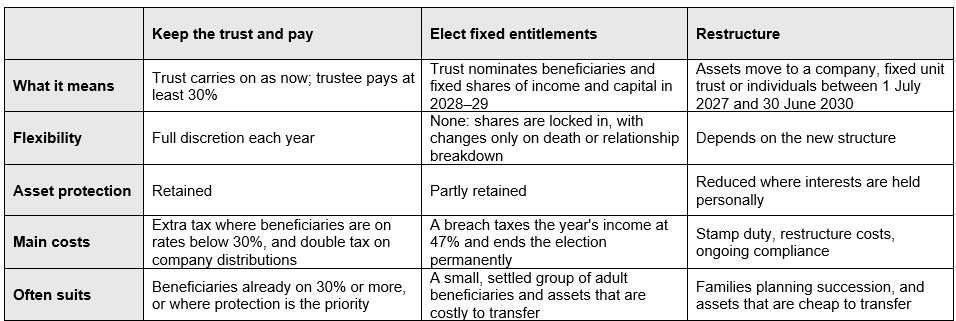
The election and the restructuring relief can't both be used for the same trust. Tax is also only one reason for having a family trust, so asset protection, control and succession should weigh in the decision too.
Don't forget estate planning.
Each option has significant implications for how your wealth passes to the next generation, and for how your trust and your will work together. Please speak with your Salt adviser before making any decisions, so the approach you choose suits your family's circumstances.
Key dates
1 July 2027: restructuring relief opens, and the CGT and negative gearing changes start.
1 July 2028: the 30% minimum tax starts.
2028–29 income year: the only year a trust can elect fixed entitlements.
30 June 2030: restructuring relief closes.
Restructuring relief is available for three full years, from 1 July 2027 to 30 June 2030. There's no rush to act before the remaining rules and any state stamp duty relief are known. Waiting does have costs, though:
The minimum tax applies in the meantime. A trust that restructures after 1 July 2028 pays the 30% tax for each year it remains a discretionary trust. Leaving it to 2030 could mean two years of the tax.
The election option closes earlier. A trust can only elect fixed entitlements during 2028–29. Once that year passes, the only choices left are to restructure or stay and pay.
The whole restructure must be finished in time. Generally all the required assets must move within the window, and keeping back a significant asset can cost the relief for the entire restructure. Valuations, lender consents and stamp duty applications can take months.
Accountants, lawyers and lenders will be busy. Many families will be restructuring at the same time, especially as the deadline nears.
For most families, the practical target is to finish the analysis during 2027–28. Where restructuring is the clear choice, aim to complete it by 30 June 2028, before the minimum tax starts. Start sooner on this as preparation and careful consideration will be key to getting the outcome appropriate for your circumstances.
What still isn't known
Stamp duty: the federal relief doesn't cover state duty. In Victoria, duty is mainly a concern where the trust holds land, directly or through a company or unit trust. Victoria hasn't yet announced any relief (there seems to be more focus on the election), and NSW's promised relief on the election isn't yet law. This will be a key factor in which option to take.
Amendment detail: the exact working of the testamentary trust amendment, and the charity integrity rules.
Restructure conditions: who may own the new company or unit trust after a restructure, and which later events could reverse the relief.
CGT and negative gearing
The follow-up capital gains tax changes we described as "not yet law" were in the same bill and have also passed. They define which homes count as new builds for negative gearing, make technical adjustments to the CGT reforms legislated in June, and exempt deceased estates, genuine testamentary trusts and special disability trusts from the 30% minimum tax on capital gains.
What to do now
There's no need to act before Christmas, however properly establishing your path forward is critical. Please contact Salt to assist you with a process to:
Review each trust's distribution pattern. Look at who receives income, their tax rates, and how much goes to companies. What will change in the future?
Model the three options for your trust(s).
Check the trust deed and your will together, so any change supports your succession plans.
Hold off on irreversible steps until the remaining details are released and the restructure rules are clear.
The right choice depends on how your trust is used, who it benefits and what it does for your family beyond tax. Please contact us to arrange a time to discuss your trust and get advice specific to your circumstances.
This article is general information only and does not take into account your personal circumstances. It is current as at 27 November 2026 and the legislation is awaiting Royal Assent. Please obtain specific advice from your Salt adviser before acting.