
Tax reform update: What's changed since the Federal Budget?
Written by Daniel Dubois

When the Federal Government announced major changes to capital gains tax (CGT), trusts and superannuation in the May 2026 Budget, our advice was simple: understand the proposals, but don't restructure your affairs based on an announcement alone. You can read our original Budget article, which explains the reforms in full, here.
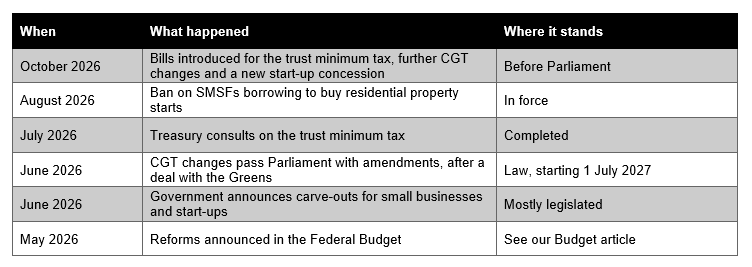
Six months on, much has changed. The core CGT reforms are now law, but only after several amendments. Further refinements are before Parliament, and the trust proposal now has draft legislation. Rather than repeat the full rules, this update focuses on what has changed since the Budget and what it means for you.
Timeline of changes since the Budget
Capital gains tax: now law, with some changes along the way
The CGT reforms passed Parliament in June 2026 and start on 1 July 2027. For most property and share investors, the core changes are as announced in the Budget: the 50% discount is replaced by an adjustment for inflation, with a minimum 30% tax on capital gains. Growth in value before 1 July 2027 keeps the 50% discount.
However, several changes were made before the law passed.
Small business owners can access a key concession more easily. The turnover threshold for the small business 50% active asset reduction has increased from $2 million to $10 million. This could significantly widen access for business owners who sell. It does not, however, lift every small business CGT concession threshold to $10 million, as each concession has its own eligibility rules.
Charitable giving is protected: Tax-deductible donations can reduce the capital gain that the 30% minimum tax applies to.
People on income support are exempt: Those receiving certain income support payments are exempt from the 30% minimum tax.
The rules for new homes are now fixed in law: Investors in eligible newly built homes can still choose the 50% discount. The Budget would have let the Government decide which properties qualified. That discretion was removed as part of the Senate deal, so the rules are now set in the legislation itself.
New detail on valuing assets at 1 July 2027: We now know more about how assets you already own will move to the new rules. Your gain will be split at 1 July 2027, using one of two values:
A market valuation as at that date, or
An apportionment formula proposed by Treasury, which estimates the value by assuming your asset grew at a steady rate over the whole time you've owned it.
Whilst you don't have to choose until you lodge the tax return for the year you sell. However, a valuation is much easier to support if the evidence is gathered at the time, particularly for property and shares in private businesses.
The choice can make a real difference. If an asset grew mostly in earlier years, the formula may push more of the gain into the period after 1 July 2027, where it is taxed more heavily. A valuation may be worth considering for long-held property, private company shares, business interests and assets bought before September 1985.
More CGT changes are before Parliament
The Government has said the CGT reforms will be finalised in stages. A second CGT bill was introduced in October 2026. It is not yet law, but it proposes changes that may matter to families:
Inheritance and separation. People who receive a residential property from a spouse through inheritance or relationship breakdown could, in certain circumstances, keep the tax treatment that applied to the original owner.
Deceased estates and certain trusts. Deceased estates, genuine testamentary trusts, special disability trusts and certain vulnerable minors would be exempt from the 30% minimum tax on capital gains.
New homes. A home would generally count as "new" if it adds to housing supply and is bought within 24 months of its occupancy certificate. The Budget proposed 12 months.
Foreign and temporary residents. Access to the discount and indexation would be based on the time spent as an Australian resident.
Further bills are expected to deal with areas such as CGT rollovers and corporate groups, so the detailed rules will keep evolving before 1 July 2027.
A new concession for start-ups
The Budget's CGT changes raised concerns about start-ups, where value can grow quickly from a very low starting point. In response, the Government has introduced a separate bill for an Innovative Business CGT concession. It would let eligible founders, employees and investors in innovative start-ups keep the option of the 50% discount.
The bill was loosened after consultation, so more businesses should qualify than under the first draft. It has passed the House of Representatives and is now before the Senate.
Superannuation: SMSFs can no longer borrow for residential property
This change wasn't in the Budget. It was added as part of the Government's deal with the Greens to pass the CGT reforms.
Since August 2026, self-managed super funds (SMSFs) can no longer enter into new limited recourse borrowing arrangements to buy residential property. Existing loans are not affected. SMSFs can still buy residential property outright, and can still borrow to buy commercial property. If your future SMSF strategy relied on borrowing to buy residential property in the future, it is worth revisiting.
Trusts: draft law has arrived, but it isn't final
The proposed 30% minimum tax on discretionary (family) trusts has moved from a Budget announcement to draft legislation. Following consultation in July, the bill was introduced to Parliament in October 2026 and is being reviewed by a Senate committee. It is not yet law, and the proposed start date remains 1 July 2028.
The legislation provides much more detail than the Budget did:
How the tax works. The trustee would pay tax of at least 30% on the trust's net income. Individual beneficiaries would receive a credit for that tax to reduce their own obligation, however this could not be refunded. Company beneficiaries would not receive a credit.
Which trusts are excluded. Fixed trusts, special disability trusts, deceased estates and super funds would be outside the regime, and distributions to charities would be excluded. A new definition of a "fixed trust" is also proposed.
Time to restructure. Relief would be available for three years from 1 July 2027 for families and business owners who want to move assets or a business out of a discretionary trust or transition the entity into a company structure. There is also an exemption to be offered whereby an election will fix beneficiary entitlements and avoid the tax, but giving up flexibility.
This detail is helpful, but it does not mean families should start dismantling existing structures. Tax has only ever been one reason for a family trust. Asset protection, succession and control of family wealth remain just as relevant.
Testamentary trusts: why your will may need a look
A testamentary trust is a trust created by your will, which comes into existence after your death. The draft law has given testamentary trusts their own set of rules, and the detail matters:
Existing testamentary trusts. Income from assets the trust already held at the Budget announcement (12 May 2026) would be excluded from the minimum tax. Income from assets added later generally would not.
Testamentary trusts that start from 1 July 2028 would only qualify if the people who can benefit are limited to individuals and tax-exempt bodies such as charities.
The second point is important because many existing wills deliberately name a wide range of possible beneficiaries, including family companies and other trusts. Under the bill as currently drafted, including even one of these could cost the trust its exemption, whether or not it ever receives anything.
And because a testamentary trust only comes into existence when someone dies, a will you signed years ago could create a new testamentary trust after the new rules start.
This part of the bill has drawn strong criticism, so it may still change. You don't need to rewrite your will every time draft legislation moves. But if your will includes a testamentary trust, now is a good time to identify it, so it can be reviewed once the final rules are known, particularly where there is a known risk that the will drafter may lose legal capacity in the near future.
What should you be doing now?
With the CGT rules now law, the planning phase for CGT has started. If you may be affected:
List the significant assets you expect to still own on 1 July 2027.
Check your records of what you paid for them and any costs added since.
Consider which assets may justify a valuation as at 1 July 2027.
If you're selling or passing on a business, have your eligibility for the small business concessions checked under the new $10 million threshold.
Model any significant sales or restructures already planned around 2027. Tax should rarely drive the decision on its own, but you can now compare acting before or after the start date.
For trusts, a more measured approach is still sensible:
Identify family trusts that rely heavily on distributing income for tax purposes.
Avoid restructuring too early while the legislation could still change.
Identify wills that include testamentary trusts, ready for review once the rules are final.
For SMSFs: if your fund planned to borrow for residential property, review your investment strategy.
Planning rather than reacting
The position today is very different from where we were straight after the Budget. The CGT reforms have moved from proposal to law, while the trust reforms are taking shape but are not yet settled.
At Salt Financial Group, our focus isn't just on responding to individual tax changes. These reforms affect trusts, companies, super, Victorian stamp duty and estate plans together, so they are a good opportunity to step back and ask whether your overall structure still suits your goals.
Where significant assets, businesses, family trusts or testamentary trusts are involved, that review is best done well before the relevant start dates. If you'd like to talk through how these changes affect you, please get in touch.
This article is general information only, current as at November 2026, and does not take into account your personal circumstances. Parts of the reforms are still before Parliament and may change. Please seek advice before acting.