
How to Draw Income Without Running Out
Written by Regan Dolling

For most of our working lives, the focus is on building our super. Once retirement arrives, the focus changes. The question becomes: how do you turn those savings into an income that will last?
That can be harder than it sounds. Nobody knows exactly how long they will live, how investment markets will perform or what unexpected expenses may arise along the way.
Draw too much too soon and there is a risk of running short later in life. Draw too little and you may unnecessarily restrict your lifestyle during the years when you have the time and energy to enjoy it.
So, what should you consider when deciding how much retirement income to draw?
1. Start With What You Need to Spend
Retirement income planning often starts with understanding how much you are likely to spend, rather than trying to predict investment returns.
As a guide, the ASFA Retirement Standard currently estimates that a comfortable retirement for homeowners aged 65 to 84 costs around $56,166 a year for a single person and $78,998 for a couple. Of course, what “comfortable” means will differ from person to person.
Essentials: food, utilities, rates, insurance and health costs
Lifestyle: travel, eating out, hobbies and helping family
One-off costs: replacing a car, home repairs or a significant holiday
This gives a more realistic picture of the income you may need than simply choosing an annual percentage to withdraw.
2. Understand the Rules for Drawing From Super
Many retirees use an account-based pension to provide an income from their super.
There is a minimum amount that must be withdrawn each financial year. For an existing pension, this is generally calculated using your account balance at 1 July and your age.
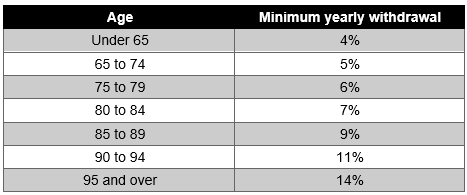
These percentages are minimum withdrawal requirements, not a guide to how much you can afford to spend.
How long your super lasts will depend on how much you withdraw, the investment returns you receive, other sources of income and, importantly, how long the money needs to last.
3. Don't Forget the Age Pension
Retirement income does not necessarily come from super alone.
Even if you do not qualify for the full Age Pension, you may still be entitled to a part pension.
From 20 September 2026, the maximum Age Pension is $1,237.70 per fortnight for a single person and $1,866.00 per fortnight for a couple combined, including relevant supplements.
For homeowners, the standard asset cut-off for receiving a part pension is currently $745,750 for a single person and $1,121,000 for a couple combined.
Because the Age Pension is means tested, your entitlement can change over time as your super balance, other assets and income change.
4. The Timing of Market Falls Matters
Once you start drawing income from your investments, it is not only the average investment return that matters. The timing of those returns can make a significant difference.
This is known as sequencing risk.
Consider two retirees who each start with $500,000 and withdraw $40,000 a year. Both receive a 6% annual return, apart from one year when their investments fall by 20%. The only difference is when that fall occurs.

Despite experiencing the same returns and making the same withdrawals, their balances after 10 years differ by around $120,000.
The reason is that Retiree A is withdrawing money from a reduced balance early in retirement, leaving less invested to benefit from future market gains.
This example is for illustration only. It is not a forecast and does not represent any particular investment.
5. Consider How Your Money Is Invested
One approach some retirees use is to separate their retirement savings into different “buckets” according to when the money is likely to be needed.
For example:
Cash: money set aside for shorter-term income needs
Defensive investments: money that may be required over the following few years
Growth investments: money intended to remain invested for the longer term
The idea is that shorter-term spending is not as dependent on selling growth investments at an unfavourable time.
This type of approach will not suit everyone. The appropriate mix of investments and cash will depend on individual circumstances, spending needs and tolerance for investment risk.
6. Build in Some Flexibility
Retirement spending does not necessarily have to remain exactly the same every year.
Some retirees choose to reduce or defer discretionary spending during weaker investment markets, while allowing more for travel or other lifestyle expenses when markets and their financial position permit.
That flexibility can be valuable because retirement may last for several decades. A plan that works at 65 may need to change as spending, health, family circumstances and financial markets change.
Bringing It All Together
There is no single withdrawal rate that will guarantee your savings last for life.
A sustainable retirement income plan needs to consider:
how much you actually need to spend
income available from the Age Pension and other sources
how your super is invested
investment returns and the timing of market movements
larger expenses that may arise
how long your savings may need to last
how much flexibility you have to adjust spending over time.
There is also another part of the equation: what happens to any super you don't spend.
Drawing enough to enjoy retirement while still managing your savings over the longer term can also affect what ultimately passes to your family. If leaving super or other assets to your children is important to you, our article “Will Your Children Lose Thousands of Dollars From Your Super?” looks at what can happen to super after death and why the way those benefits are structured can matter.
Talk to Us
The right level of retirement income will be different for everyone.
If you would like to understand how long your savings could last, how much income you can draw or how your super and Age Pension may work together, contact Salt Financial Group to arrange a meeting with our Financial Planning team.